 |
| This is a Tundra in the Winter |
Wednesday, February 10, 2016
Tundra
The tundra is a treeless biome that is located lower parts of the Arctic Circle and Antarctica. For most of the year, it is winter where there are long dark nights and it is extremely cold and dry. The yearly precipitation is lower than 10 inches and the landscape is usually covered in snow. There is a layer permanently of frozen soil called permafrost under the ground. This and the cold temperatures that make it hard to decompose creates a thin layer of soil to grow in so there are no trees. There are many lakes because water can't seep into the ground. Most animals migrate to the tundra in the summer and migrate away in the winter, but a few animals such as the Arctic fox, the Arctic hare and lemmings stay all year long. These animals change their coats each season accordingly.

Grasslands
 |
| This is a Grassland with Bison Grazing On It |
Grasslands can be found in every continent except for Antarctica. There is not enough rainfall to have trees and does not fall below 10-25 cm. of rain per year. There are many different names for grasslands. They are called steppe in Europe and Asia, Prairie in North America, Veldt in Africa, and Pampas in South America. There might have been grasslands covering half of the world at one time. Grassland also have such a slow decomposition rate that the soil in grasslands are the most fertile in the world. Lots of them are used for agriculture and are called the breadbaskets of the world. Many different animals live in grasslands in different parts of the world. They include rattle snakes, bison, antelope, coyotes and many more!
Taiga
 |
| This is a Taiga |
Taigas are found further north. The dominant organisms are conifers such as spruce. The climate is generally long winters which makes it so there is only a short growing season. There are very cold temperatures and much of the precipitation is snow. Some of the animals found here are caribou, deer, elk, mountain lions, timber wolves, black bears, chipmunks, and beavers.
Deciduous Forests
 |
| This is a Deciduous Forest |
Deciduous Forests are found at about 60 degrees latitude north and south. They have cold winters and warm summers. They have a good amount of rainfall that comes throughout the year. The temperatures are average and they are dominated by deciduous trees. The soil is rich in nutrients. There are many different types of birds and mammals such as deer, foxes, squirrels, and raccoons.
Deserts
 |
| This is a Desert |
The deserts are found at latitudes of 30 degrees north to 15 degrees north and 15 degrees south and 30 degrees south. Deserts are very hot. Deserts support very little life and is dominated by rocks and mostly poor soil. Different deserts have a wide variety of plants mostly depending on rainfall. Deserts that receive and inch of rain have highly specialized plants. The plants there complete most if not all of their life cycle in less than a year when it rains, these plants are called annuals. Most desert plants are perennials. These are plants like the american cactus. They are woody shrubs that have large shallow roots to quickly soak up water. Animals also live in the desert. Animals like birds, snakes, tortoises, and small rodents. There are larger animals like the desert bighorn sheep. Most of the animals in a desert are nocturnal to escape the dry, hot sun.
Tropical Rain Forests
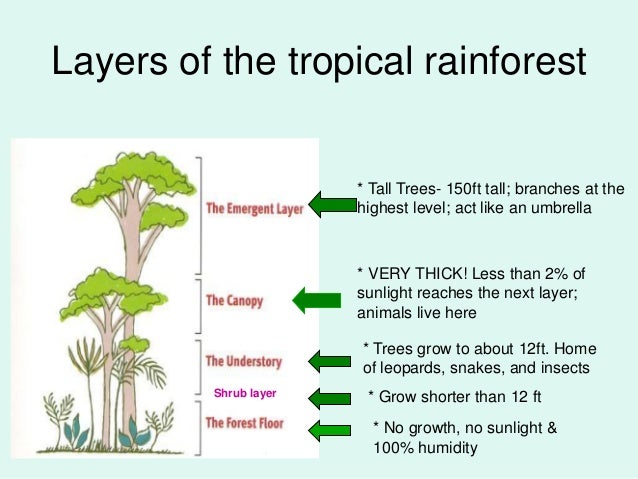 |
| This Shows the Different Layers of the Tropical Rain Forests |
Subscribe to:
Comments (Atom)